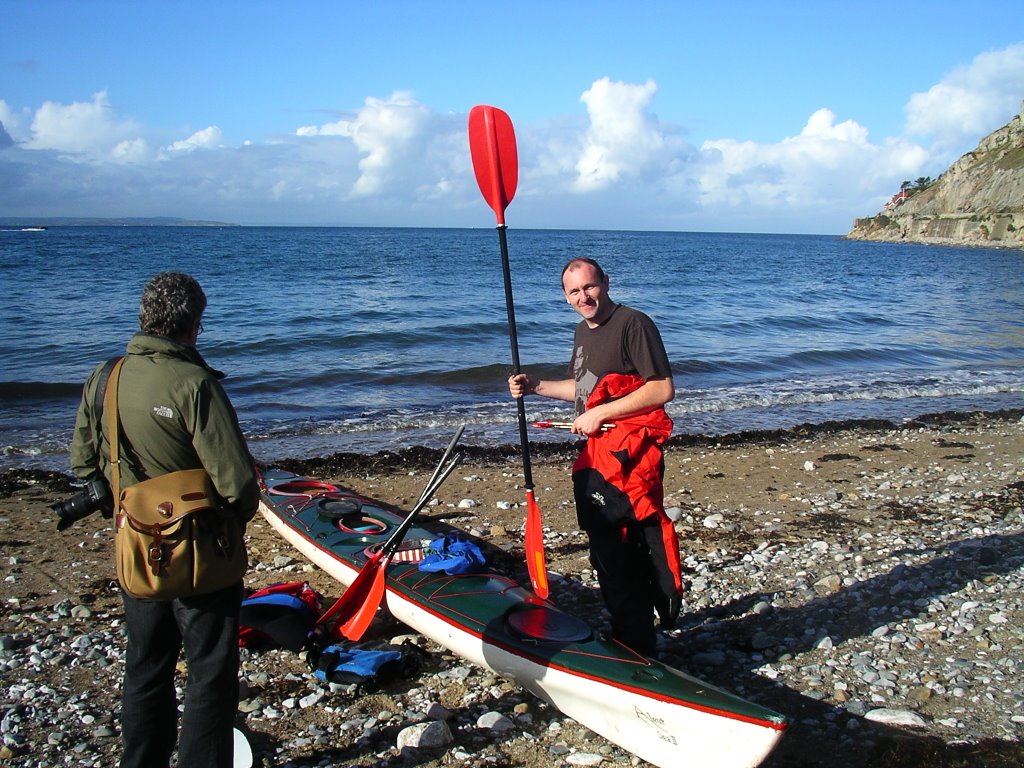
Last weekend's work commitments took me to the Gower peninsula in south Wales. Without hesitation I packed my kayak and got in touch with local paddler Eurion Brown. We met up on the Friday evening at Port Eynon for a short sunset paddle and quickly discovered that this coastline is something special.
This smugglers cove has a tower built of stone set deep into its gully. If these walls could talk they would tell tall tales of smuggling brandy, tobacco and pirates booty.
The lack of air traffic left the skies clear of vapour trails. A wonderful sunset was our cue to head back to reach Port Eynon before dark.
The following day Eurion and I paddled the section from Port Eynon to Llangennith. This classic journey took us past Paviland Cave and on towards Three Cliffs Bay before rounding Worms Head. The towering limestone cliffs and pinnacles with sweeping grassy meadows between them are reminiscent of summer alpine scenes. No doubt this is why walkers and climbers are drawn to these shores.
Tuesday, April 20, 2010
Thursday, April 08, 2010
Northumberland at Easter
The Northumberland is blessed with a wild, bleak and beautiful coastline full of adventure. Kirstine and I braved the A1 with thousands of others for the great Easter get away. By late evening we were established in our lodgings at Farne Diving Services in the village of Beadnell.
On Good Friday morning the beach at Beadnell Haven was bristling with wildlife. Eider ducks were so busy squabbling over who should mate with who that they hardly noticed me sneaking up on then with my camera.
The tide was on its way out and the wading birds were tucking into the fresh feast exposed along the sands.
Most interesting were a small group of 'bar tailed godwits' possibly part-way through migration to their breeding grounds in higher lattitudes.
On Saturday Kirstine and I paddled out to the Inner Farne to look for some more wildlife. Before long we spotted the first of what seemed like a million puffins. Kittiwakes, guillemots, razorbills and shags have also arrived in readiness for the breeding season.
Sunday morning was a little fuzzy due to a few extra beers in the Craster Arms. I left Kirstine to rest whilst I met up with local kayak guide Ollie Jay for a trip out to the Longstone. The Longstone is one of the outermost Farne islands and after stopping for a hot drink beside the lighthouse we had fun nipping in and out of the tide races that rush between the kelp infested rocks. Some of the seals followed us for over a mile until we were well on our way back to St Aidan's beach near Seahouses.
On Good Friday morning the beach at Beadnell Haven was bristling with wildlife. Eider ducks were so busy squabbling over who should mate with who that they hardly noticed me sneaking up on then with my camera.
The tide was on its way out and the wading birds were tucking into the fresh feast exposed along the sands.
Most interesting were a small group of 'bar tailed godwits' possibly part-way through migration to their breeding grounds in higher lattitudes.
On Saturday Kirstine and I paddled out to the Inner Farne to look for some more wildlife. Before long we spotted the first of what seemed like a million puffins. Kittiwakes, guillemots, razorbills and shags have also arrived in readiness for the breeding season.
Sunday morning was a little fuzzy due to a few extra beers in the Craster Arms. I left Kirstine to rest whilst I met up with local kayak guide Ollie Jay for a trip out to the Longstone. The Longstone is one of the outermost Farne islands and after stopping for a hot drink beside the lighthouse we had fun nipping in and out of the tide races that rush between the kelp infested rocks. Some of the seals followed us for over a mile until we were well on our way back to St Aidan's beach near Seahouses.
Tuesday, March 16, 2010
Anglesey Chill
Kirstine and I broke Manchester's Friday surface tension and catapulted ourselves towards north Wales for a weekend of kayaking fun with North West Sea Kayakers. Its always good to meet up with old friends. Soon enough we were washing down some spicy broth with a glass or two of warming winter ale topped off with slack handful of tall stories.
Most of the collaborators were hatching plans for a late start but I was feeling too enthusiastic to hang around. By 8 o'clock on Saturday morning 5 of us were scurrying around dragging kit to the bay at Rhoscolyn in readiness for a 35km anti-clockwise circumnavigation of Holy Island. By the time we had crossed the Inland Sea and approaching Holyhead Harbour I was feeling my lack of fitness. Waiting for a fast ferry to pass in front of us gave a welcome breather.
The tide race at North Stack was in fine foamy form and comanding respect with its legions of munching waves. We had a brief respite resting and exploring the caves of Gogarth Bay before moving on. My new carbon fibre paddles from Mitchell Blades were making all the difference in my tiring state. The smooth crisp entry to the water combined with their light weight deliver plenty of power when its needed but requiring a little less effort.
We left South Stack behind us as we crossed Abrahams Bosom and Trearddur Bay and soon arrived back at Rhoscolyn in the chilly late afternoon.
Thawing out from a chilly adventure is a fine art. A careful blend of freshly baked pizzas, and a plenty of good wine lead to cheery banter and ultimately sound sleep.
The following day started with a lot of plotting and scheming of future trips. Sundays paddling was shorter but sweeter in the dazzling sunshine. Once Kirstine got hold of my shiny new paddles it was difficult to retreive them!
Most of the collaborators were hatching plans for a late start but I was feeling too enthusiastic to hang around. By 8 o'clock on Saturday morning 5 of us were scurrying around dragging kit to the bay at Rhoscolyn in readiness for a 35km anti-clockwise circumnavigation of Holy Island. By the time we had crossed the Inland Sea and approaching Holyhead Harbour I was feeling my lack of fitness. Waiting for a fast ferry to pass in front of us gave a welcome breather.
The tide race at North Stack was in fine foamy form and comanding respect with its legions of munching waves. We had a brief respite resting and exploring the caves of Gogarth Bay before moving on. My new carbon fibre paddles from Mitchell Blades were making all the difference in my tiring state. The smooth crisp entry to the water combined with their light weight deliver plenty of power when its needed but requiring a little less effort.
We left South Stack behind us as we crossed Abrahams Bosom and Trearddur Bay and soon arrived back at Rhoscolyn in the chilly late afternoon.
Thawing out from a chilly adventure is a fine art. A careful blend of freshly baked pizzas, and a plenty of good wine lead to cheery banter and ultimately sound sleep.
The following day started with a lot of plotting and scheming of future trips. Sundays paddling was shorter but sweeter in the dazzling sunshine. Once Kirstine got hold of my shiny new paddles it was difficult to retreive them!
Sunday, March 07, 2010
A trip to the Mitchell Blades paddle factory
In the the darkness of mid-winter I was dreaming of warm the sunny sea kayaking days and the coming summer season. It was time to think about a change of paddle. I had become quite attached to my old blades but they were a little heavy and outdated.
There are plenty of lovely paddles to choose from in the shops, but I quickly became curious about nearby Chester based paddle maker Lance Mitchell. Having worked with relatives Dave & Peggy making paddles in the USA, Lance returned to Chester in 2002 to set up his own company, 'Mitchell Blades'. I like to support local small businesses so I got in touch with Lance and before I knew it I had placed an order.
When I arrived at the modest-sized workshop, Lance was applying the finishing touches to my paddle. He is fanatical about attention to detail and proud of his unique manufacturing techniques. Before I left Lance talked me through the manufacturing process and gave me a quick guided tour.
There are plenty of lovely paddles to choose from in the shops, but I quickly became curious about nearby Chester based paddle maker Lance Mitchell. Having worked with relatives Dave & Peggy making paddles in the USA, Lance returned to Chester in 2002 to set up his own company, 'Mitchell Blades'. I like to support local small businesses so I got in touch with Lance and before I knew it I had placed an order.
When I arrived at the modest-sized workshop, Lance was applying the finishing touches to my paddle. He is fanatical about attention to detail and proud of his unique manufacturing techniques. Before I left Lance talked me through the manufacturing process and gave me a quick guided tour.
All that remains is for me to get my new paddles wet!
Thursday, February 04, 2010
Kayak Coast2Coast - The Movie
The Kayak Coast 2 Coast team have gathered up some of the footage and photographs from last years trip to make a short film to tell the story. I asked my friend Helen Lagoe if she would help and she kindly agreed. Helen has done and wonderful job with the video editing. She has whipped up a really watchable film out of a collection of photos and what must have seemed like an endless string of footage.

Another friend, Michael McGoldrick let us use some of the music from his albums: 'Morning Rory' and 'Fused'.
The 12 minute film will be featured at the increasingly popular Sheffield Adventure Film Festival in one of the 'On the Edge' evenings. Kayak Coast 2 Coast can be viewed at 'Cafe Euro' 7.00pm Saturday 6th March.
7th March update - If you missed the screening in Sheffield you can watch it by clicking here.
Sunday, January 17, 2010
A thaw comes to north Wales
Most of the snow and ice has now dissapeared from Manchester but my apetite for fun in the snow is still as healthy as ever. My brother Chris and I have been for a spot of wintry walking in the Carneddau hills of northern Snowdonia.
The quick ascent of Pen yr Ole Wen brought us stunning views across the Ogwen Valley. The strange morning light refracted through the low cloud to colour snow patches from pinks and oranges to different shades of blue. The rest of the ascent was a chore as my hill fitness is in great need of improvement right now.
From the summit of Pen yr Ole Wen we stumbled into a cold icy cloud in search of Carnedd Dafydd. After an uphill slog over icy stones and through deep snow drifts we arrived at the summit and checked in at the shelter. It was a good opportunity to check the map but we also made time for a well earned snack.
We took the gentler slopes that lead back to the Ogwen Valley via Cwm Lloer. The snow conditions allowed us to simply sit back, relax and enjoy the view whilst descending at a fair rate of knots.
All too soon we were leaving the melting snows behind and heading back into the valley and mentally preparing for the journey home.
The quick ascent of Pen yr Ole Wen brought us stunning views across the Ogwen Valley. The strange morning light refracted through the low cloud to colour snow patches from pinks and oranges to different shades of blue. The rest of the ascent was a chore as my hill fitness is in great need of improvement right now.
From the summit of Pen yr Ole Wen we stumbled into a cold icy cloud in search of Carnedd Dafydd. After an uphill slog over icy stones and through deep snow drifts we arrived at the summit and checked in at the shelter. It was a good opportunity to check the map but we also made time for a well earned snack.
We took the gentler slopes that lead back to the Ogwen Valley via Cwm Lloer. The snow conditions allowed us to simply sit back, relax and enjoy the view whilst descending at a fair rate of knots.
All too soon we were leaving the melting snows behind and heading back into the valley and mentally preparing for the journey home.
Wednesday, January 13, 2010
At home on the piste
During this last couple of snowy weeks it has been like living in a different country. The recent cold snap has delivered more snow than I can remember. The journey to work has taken longer and much more effort so when the weekend arrived with blue skies and sunny weather it was time to make the best of the conditions.
Plenty of deep powdery snow meant that Kirstine and I could ski nordic style right from the garden into the wide open spaces of the Mersey Valley.
Unfortunately, our afternoon of fun was cut short when Kirsine's boots started to come apart like comedy clown shoes. We headed home to study shoe repair manuals over steaming mugs of hot chocolate.
Plenty of deep powdery snow meant that Kirstine and I could ski nordic style right from the garden into the wide open spaces of the Mersey Valley.
Unfortunately, our afternoon of fun was cut short when Kirsine's boots started to come apart like comedy clown shoes. We headed home to study shoe repair manuals over steaming mugs of hot chocolate.
Saturday, January 09, 2010
Don't eat yellow snow
Huge and characterful snowmen and imaginative snow sculptures have sprung up everywhere in the lest few days.
This snow toilet certainly made me flushed with excitement. There is even a mini chocolate bar floating in the pan waiting to be dispatched!
Wednesday, January 06, 2010
...on a cold an frosty morning!
The main roads in Manchester have provided plenty of challenges for people trying to get to work. Snow and ice have closed most schools and left the emergency services heavily stretched. At times bus services have been suspended. Driving is difficult, walking any distance is tricky and this is no weather for cycling to work. So just how do you get to work on a day like this like this?
I have been making good use of the current conditions and remembering the old nursery rhyme: "This is the way we go to work on a cold and frosty morning!"
Gath'ring winter fu-u-el
Its official! This is the most prolonged cold snap in the las 30 years. It seems a long time since the first snow affected transport in Manchester back in late December.
Christmas and New Year came and went with many people having to make difficult choices to change their plans for the festive season. A few of us managed to gather up a few logs and huddle round a fire in the back garden. We donned warm hats and big coats for a festive barbeque in the snow with mulled wine and German sausages.
And still the snow comes...
Christmas and New Year came and went with many people having to make difficult choices to change their plans for the festive season. A few of us managed to gather up a few logs and huddle round a fire in the back garden. We donned warm hats and big coats for a festive barbeque in the snow with mulled wine and German sausages.
Tuesday, November 03, 2009
Spurn Head
I managed to get a paddle in on Saturday before the weather broke in such dramatic style on Sunday. I went to the east coast to paddle around the iconic headland and nature reserve of Spurn Head. I met up with Richard, Sabina, Ron and Kate at the Spurn Heritage Coast Visitor Centre at Kilnsea Beach.
Spurn Head is a fragile spit of land made up of sand and pebbles bound together with marram grass and sea buckthorn. In places this 6 kilometre long spit is less than 50 metres wide. Spurn protects the Humber like a huge breakwater keeping the stormy nature of the North Sea at bay.
The coastal erosion here means that the shore is receeding at around 2 metres each year and the way down to the beach can be a little awkward.
Once out through the surf we enjoyed the assistance of the south-going tidal stream as we passed numerous anglers on our way to the point.
We stopped for a play in the overfalls where there is a sand bank and an area of shallows called 'Stony Binks' close to the end of the headland. From here we could see the old Bull Sand Fort which stands in the middle of the mouth of the Humber. The fort was built in WW1 as part of the coastal defence network.
Once round the end of Spurn we were in smooth waters paddling past the pilot station and jetty, 2 disused lighthouses and the only lifeboat station manned by full-time residential staff. I was spotted by the coxwain, Dave who I had met earlier in the year when 4 of us finished the Kayak Coast 2 Coast trip here raising over £2000 for the RNLI. We had just a brief chat before moving on to paddle up the inner shore of Spurn.
Birds were swarming all around us as the sinking sun lit the inner shore with a golden autumnal glow. The water was strangely smooth yet we could hear the boom of surf dumping on the outer beach, just accross the road on the other side of the spit.
Finally, we reached the shore next to the Crown and Anchor pub and after 14 kilometres of paddling we only had 700 metres to walk to our cars.
Spurn Head is a fragile spit of land made up of sand and pebbles bound together with marram grass and sea buckthorn. In places this 6 kilometre long spit is less than 50 metres wide. Spurn protects the Humber like a huge breakwater keeping the stormy nature of the North Sea at bay.
The coastal erosion here means that the shore is receeding at around 2 metres each year and the way down to the beach can be a little awkward.
Once out through the surf we enjoyed the assistance of the south-going tidal stream as we passed numerous anglers on our way to the point.
We stopped for a play in the overfalls where there is a sand bank and an area of shallows called 'Stony Binks' close to the end of the headland. From here we could see the old Bull Sand Fort which stands in the middle of the mouth of the Humber. The fort was built in WW1 as part of the coastal defence network.
Once round the end of Spurn we were in smooth waters paddling past the pilot station and jetty, 2 disused lighthouses and the only lifeboat station manned by full-time residential staff. I was spotted by the coxwain, Dave who I had met earlier in the year when 4 of us finished the Kayak Coast 2 Coast trip here raising over £2000 for the RNLI. We had just a brief chat before moving on to paddle up the inner shore of Spurn.
Birds were swarming all around us as the sinking sun lit the inner shore with a golden autumnal glow. The water was strangely smooth yet we could hear the boom of surf dumping on the outer beach, just accross the road on the other side of the spit.
Finally, we reached the shore next to the Crown and Anchor pub and after 14 kilometres of paddling we only had 700 metres to walk to our cars.
Monday, October 19, 2009
St Bees in the Sun
The settled weather of last week continued into the weekend giving Saturday the potential to be a glorious day. With this in mind I was easily tempted out to the west Cumbrian coast for a paddle round St Bees Head.
The name of St Bees is most likely to be linked to St Bega who arrived upon these shores during the 7th Century from Ireland via the Isle of Man. Records of her travels keep cropping up along the shores of northern England. We set out from the beach at St Bees close to the lifeboat station and the beginning of Alfred Wainwright's modern day pilgrim's way.
The red sandstone cliffs here rise over 80 metres vertically from the sea. South of the main headland the buttresses are regularly spaced along the cliff line like huge curtain folds.
The sea was unusually calm and we chatted to some climbers who were taking advantage of the warm autumn sunshine and getting a few routes done.
There was only one thing for it when we arrived at Whitehaven harbour. We headed for the chip shop!
We spent too long on lunch so the journey back was a little more hurried than it looks in the photo above.
The name of St Bees is most likely to be linked to St Bega who arrived upon these shores during the 7th Century from Ireland via the Isle of Man. Records of her travels keep cropping up along the shores of northern England. We set out from the beach at St Bees close to the lifeboat station and the beginning of Alfred Wainwright's modern day pilgrim's way.
The red sandstone cliffs here rise over 80 metres vertically from the sea. South of the main headland the buttresses are regularly spaced along the cliff line like huge curtain folds.
The sea was unusually calm and we chatted to some climbers who were taking advantage of the warm autumn sunshine and getting a few routes done.
There was only one thing for it when we arrived at Whitehaven harbour. We headed for the chip shop!
We spent too long on lunch so the journey back was a little more hurried than it looks in the photo above.
Monday, September 28, 2009
The Industrial North-East
The coast between Yorkshire and Northumberland is one of little known beauty and poorly hidden beasts. Brian, Peter and I met at the historic headland at Hartlepool on Friday morning for a paddle to Teesmouth. The launching spot is down a set of steps through a sandstone archway the old town wall onto a small beach called Fish Sands. As we paddled along the shores of Hartlepool Bay we kept ourselves entertained in the surf that was breaking gently on the smooth sands of Seaton Carew.
The industrial tangle of Teesmouth makes a dramatic backdrop to an otherwise flat coastline.
On Saturday we were joined by Glen and his partner Dee. Whilst us lads set about paddling from Blyth to Cresswell, Dee helped with the logistics before looking for some horses to ride. Heading north from Blyth the coastline has all of the trappings of heavy industry (more past than present). The scenery begins to show signs of rural life where the River Wansbeck enters the sea on the approaches to Newbiggin-by-the-Sea.
To help prevent coastal erosion Newbiggin Bay has a new breakwater complete with a huge sculpture of a couple gazing out to sea.
Lynemouth Bay lies to the north and hosts the aluminium works and power plant creating an awkward interruption to the otherwise slow but sure transition from industrial to rural coastline.
Journeys end was on the unspoilt sands of Druridge Bay just outside the rosy village of Cresswell in Northumberland.
Sunday morning saw us heading to North Shields at Tynemouth for a trip north along the coast to Blyth where we had started our trip the day before. We Paddled out of the River Tyne entrance and turned north beneath the iconic silhouette of the Tynemouth Priory. We paid a brief visit to Longsands beach where Glen swam in the challenging 6 inch surf.
We passed St Mary's Lighthouse before battling with strong offshore winds as we passed Seaton Sluice on our way to finish the day at Blyth Beach.
Finally, on Monday Brian, Peter and I finished off with a short paddle round Coquet Island before starting the long haul home back west.
The industrial tangle of Teesmouth makes a dramatic backdrop to an otherwise flat coastline.
On Saturday we were joined by Glen and his partner Dee. Whilst us lads set about paddling from Blyth to Cresswell, Dee helped with the logistics before looking for some horses to ride. Heading north from Blyth the coastline has all of the trappings of heavy industry (more past than present). The scenery begins to show signs of rural life where the River Wansbeck enters the sea on the approaches to Newbiggin-by-the-Sea.
To help prevent coastal erosion Newbiggin Bay has a new breakwater complete with a huge sculpture of a couple gazing out to sea.
Lynemouth Bay lies to the north and hosts the aluminium works and power plant creating an awkward interruption to the otherwise slow but sure transition from industrial to rural coastline.
Journeys end was on the unspoilt sands of Druridge Bay just outside the rosy village of Cresswell in Northumberland.
Sunday morning saw us heading to North Shields at Tynemouth for a trip north along the coast to Blyth where we had started our trip the day before. We Paddled out of the River Tyne entrance and turned north beneath the iconic silhouette of the Tynemouth Priory. We paid a brief visit to Longsands beach where Glen swam in the challenging 6 inch surf.
We passed St Mary's Lighthouse before battling with strong offshore winds as we passed Seaton Sluice on our way to finish the day at Blyth Beach.
Finally, on Monday Brian, Peter and I finished off with a short paddle round Coquet Island before starting the long haul home back west.
Monday, September 21, 2009
Earl-aye on the Solway
Since the excitement of last year's Solway adventures with Sean passed, I have been keen to make another crossing from Cumbria to Scotland.
Jon, Dave and I assembled at the slipway in Maryport harbour and got on the water as the tide was almost half way in. Following a week of delightful weather Saturday morning greeted us dull, grey and breezy. Leaving the shelter of the harbour we engaged the open rolling sea but our destination was barely visible 18km away through gloom.
With over half of the crossing done, and with onset of better weather the Scottish shore became more visible across the wide open expanse of water. This is when we began to realise that we had under estimated the strength of the Solway tide.
We missed Southerness Point by at least 2km and settled for the nearby beach close to the Thirl Stane natural arch.
The waters of the Solway have a reputation for becoming alarmingly rough with little provocation from the prevailing weather and soon after we set out on our return wind against tide conditions soon became tricky.
Each of the crossings ended up being 20km taking a little over 3 hours but the breezy weather and choppy seas made it seem longer. Better weather came only a short while after we had battled our way over the Solway from Scotland.
Jon, Dave and I assembled at the slipway in Maryport harbour and got on the water as the tide was almost half way in. Following a week of delightful weather Saturday morning greeted us dull, grey and breezy. Leaving the shelter of the harbour we engaged the open rolling sea but our destination was barely visible 18km away through gloom.
With over half of the crossing done, and with onset of better weather the Scottish shore became more visible across the wide open expanse of water. This is when we began to realise that we had under estimated the strength of the Solway tide.
We missed Southerness Point by at least 2km and settled for the nearby beach close to the Thirl Stane natural arch.
The waters of the Solway have a reputation for becoming alarmingly rough with little provocation from the prevailing weather and soon after we set out on our return wind against tide conditions soon became tricky.
Each of the crossings ended up being 20km taking a little over 3 hours but the breezy weather and choppy seas made it seem longer. Better weather came only a short while after we had battled our way over the Solway from Scotland.
Tuesday, September 01, 2009
recent highlights
A couple of weeks ago I met up with Kate Duffus who is a sea kayaking coach based in south Cumbria. A while ago she devised a navigation exercise in the northern part of Morecame Bay. The idea is to find a sandbank called 'South America' and a couple of islands; one called 'St Helena' and the other called 'Falklands'. These features are only detailed on the Ordnance Survey 1:25000 scale map and are only exposed at low water on a spring tide.
We found St Helena hiding beneath thousands of starfish but South America was so huge we couldn't paddle round it to find the Falklands. For more of the story have a look at Kate's account.
This last weekend Kirstine and I joined Terry for a paddle from Whitby along the towering cliffs to Robin Hood's Bay and back.
The cliffs are colossal and rise to over 60 metres.
Whilst Terry was posing for photos the naughty seals kept popping up in the background and pulling funny faces.
We found the perfect place for a balanced nutritional meal at Robin Hood's Bay to give us plenty of energy for the paddle back to Whitby.
This last weekend Kirstine and I joined Terry for a paddle from Whitby along the towering cliffs to Robin Hood's Bay and back.
Subscribe to:
Posts (Atom)